
Reliance Industries Shares Slump 4.1%, Lose ₹80,000 Crore Market Cap in One Day – Export Duty & Oil Crisis Hit Hard
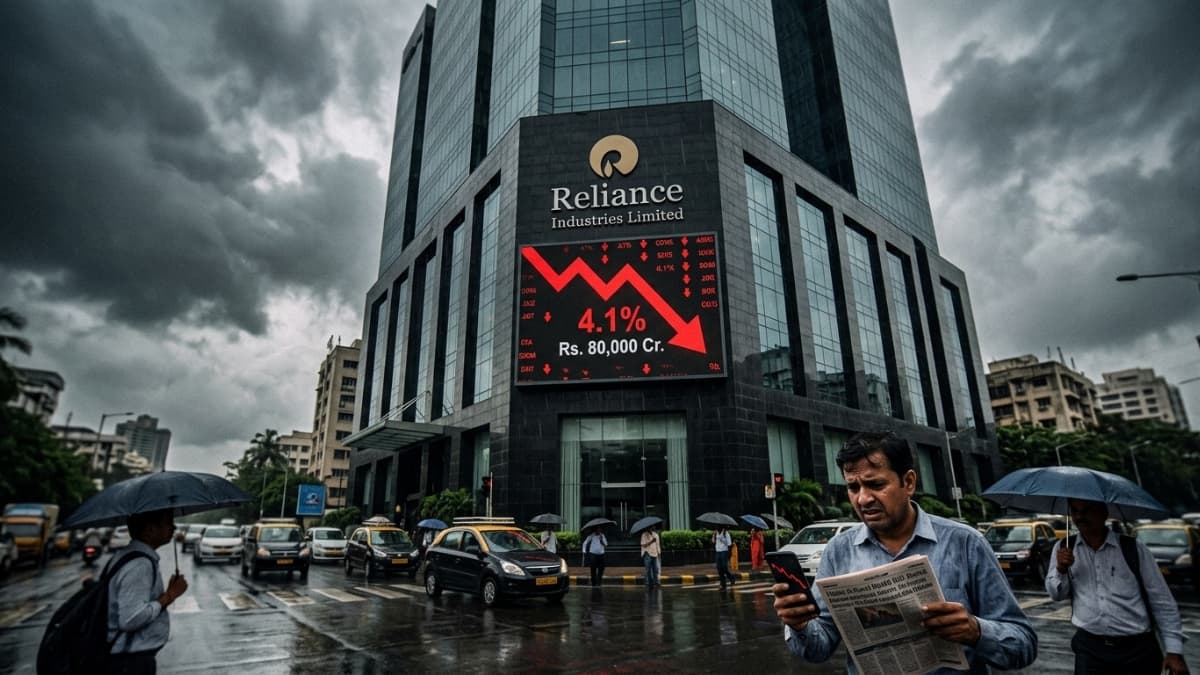
New Delhi, March 27, 2026: India’s largest company by market value, Reliance Industries Ltd (RIL), witnessed a sharp sell-off on Friday, with shares tumbling more than 4.1% intraday and wiping out approximately ₹80,000 crore in investor wealth in just one trading session.
The stock hit an intraday low of ₹1,353.20, down 4.23% from Wednesday’s closing price of ₹1,413.10 (market was closed Thursday on account of Shri Ram Navami). By mid-afternoon, shares were trading around ₹1,354.50–₹1,354.80, reflecting a 4.1–4.2% decline. This pushed the company’s market capitalisation down from around ₹19.12 lakh crore (Wednesday close) to approximately ₹18.32 lakh crore.
The steep fall comes amid a double whammy of policy and global factors weighing heavily on the oil-to-telecom conglomerate’s refining business.
Key Triggers Behind the Sharp Decline
-
Government Imposes Export Tax Levy on Petrol & Diesel Union Minister for Petroleum and Natural Gas Hardeep Singh Puri announced on Friday that any refinery exporting petrol or diesel to foreign markets must now pay an export tax. The move aims to ensure adequate domestic supply and reduce the massive under-recoveries faced by oil marketing companies (OMCs) amid skyrocketing global fuel prices.
The government has already slashed excise duties significantly — petrol from ₹13 to ₹3 per litre and diesel to nil from ₹10 per litre — to absorb 30–40% of OMC losses. However, the new export duty directly hits realisations on exported volumes, putting pressure on refining margins.
-
Soaring Crude Oil Prices Amid Geopolitical Tensions Global crude prices surged on fears of supply disruptions from the ongoing US-Iran conflict and near-zero tanker traffic through the Strait of Hormuz. India’s crude oil basket jumped to $123.15 per barrel, while Brent futures climbed 0.90% to $102.73 per barrel.
Higher input costs further squeeze gross refining margins (GRMs) for players like Reliance, whose Jamnagar refinery is the world’s largest single-location facility.
-
Reliance’s Clarification on Iranian Crude Reports In a regulatory filing on March 26, Reliance categorically rejected media reports alleging purchase of Iranian-origin crude, calling the claims “entirely baseless, factually incorrect, and misleading.” The clarification, however, failed to stem the selling pressure triggered by broader sector concerns.
Broader Market Impact
The sell-off in RIL also dragged other refiner and OMC stocks, with some declining up to 6%. The development comes at a time when RIL is already down nearly 14% year-to-date in 2026, despite strong long-term performance (over 35% returns in five years). The 52-week high stands at ₹1,611.80 (January 5, 2026), while the 52-week low is ₹1,114.85.
What This Means for Investors
The export duty levy threatens to compress RIL’s high-margin export revenues from its refining segment, which has historically been a key profit driver. With global crude prices elevated due to Middle East tensions, near-term margin pressure is likely to persist unless crude prices moderate or the government provides further relief.
Analysts will now closely watch RIL’s upcoming quarterly updates for any guidance on refining margins, export strategy, and the impact of the new policy. Long-term investors, however, may view the correction as an opportunity given the company’s diversified portfolio — Jio’s telecom leadership, Reliance Retail’s scale, and ambitious new energy initiatives.
Outlook
While the immediate trigger is policy-driven, the combination of export duty and geopolitical oil volatility has created short-term uncertainty. Market participants will monitor any further government clarifications on the levy and developments in the Strait of Hormuz situation.
RIL remains a heavyweight on the Nifty 50 and Sensex, so its performance continues to influence broader market sentiment. Investors are advised to track volume trends and any potential support levels around ₹1,340–1,350 in the coming sessions.