
NITI Aayog Launches DPI@2047 Roadmap to Drive Inclusive Growth
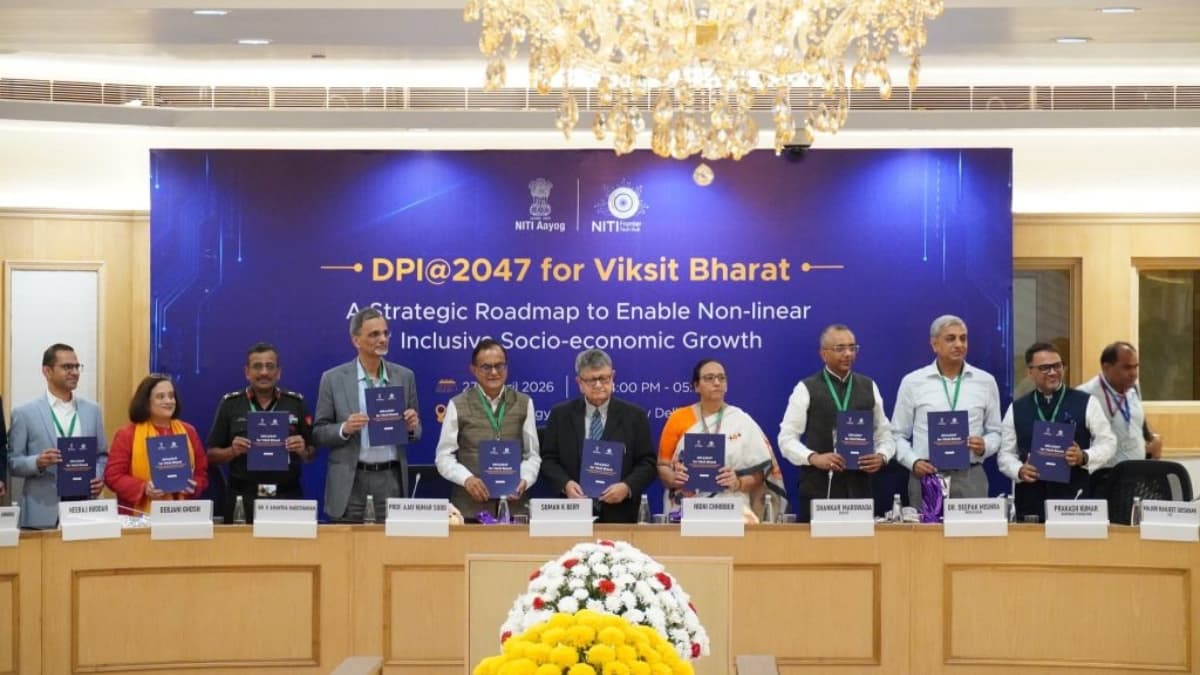
New Delhi: NITI Aayog has unveiled the DPI@2047 roadmap, a strategic vision designed to guide the next phase of India’s Digital Public Infrastructure (DPI) journey and accelerate inclusive, productivity-led growth. The roadmap was launched on April 27, 2026, as part of the country’s broader ambition to achieve Viksit Bharat by 2047.
A New Phase of India’s Digital Transformation
The roadmap was formally unveiled by Suman Bery, Vice Chairman of NITI Aayog, and Ajay Kumar Sood, Principal Scientific Adviser to the Government of India. The launch event was attended by several senior policymakers and industry leaders, including Nidhi Chhibber, CEO of NITI Aayog; V. Anantha Nageswaran, Chief Economic Adviser; Debjani Ghosh, Distinguished Fellow at NITI Aayog; and Shankar Maruwada, Co-Founder and CEO of the EkStep Foundation.
Developed in partnership with EkStep Foundation and Deloitte, the roadmap lays out a two-phase strategy:
- DPI 2.0 (2025–2035): Focused on livelihood-led growth and removing structural bottlenecks.
- DPI 3.0 (2035–2047): Aimed at enabling broad-based prosperity across the economy.
From Digital Inclusion to Productivity-Led Growth
The initiative marks a shift from expanding digital access toward enhancing productivity, livelihoods, and market access. While earlier digital public infrastructure focused on identity, payments, and welfare delivery, the next phase aims to extend digital rails into key economic sectors such as:
- MSMEs
- Agriculture
- Education
- Healthcare
The roadmap identifies eight sectoral transformations and outlines four key execution priorities:
- District-level demand aggregation
- Scaling technology entrepreneurship
- Leveraging artificial intelligence
- Enabling cross-sector collaboration through trusted data, digital transactions, and human capacity building
Leveraging AI and Ecosystem Innovation
A central theme of the DPI 2.0 vision is the democratisation of AI and trusted data flows. The roadmap emphasises that the future of technological leadership will depend not only on innovation but on the ability to scale and integrate technologies across sectors and populations.
Suman Bery highlighted the shift from GDP-centric growth to productivity-driven development, noting that higher incomes and employment quality depend on sustained productivity gains enabled by AI and digital infrastructure.
Ajay Kumar Sood emphasised the need to combine scientific rigour, interoperability, and safeguards to ensure responsible deployment of emerging technologies at scale.
Supporting States and Local Implementation
A major component of the roadmap focuses on empowering states through practical implementation pathways. Nidhi Chhibber noted that faster state-level growth will accelerate national progress, positioning DPI as a powerful enabler of inclusive development.
Toward Viksit Bharat 2047
The DPI@2047 roadmap represents a significant evolution in India’s digital journey. By integrating open digital infrastructure, AI, and entrepreneurship, the initiative aims to create population-scale impact, boost productivity, and unlock new opportunities across sectors.
With execution now the priority, the roadmap provides a structured pathway to help India transition toward non-linear, inclusive growth and achieve its long-term development vision for 2047.