
PSU Funds vs Sectoral Funds: Which One Should You Choose?
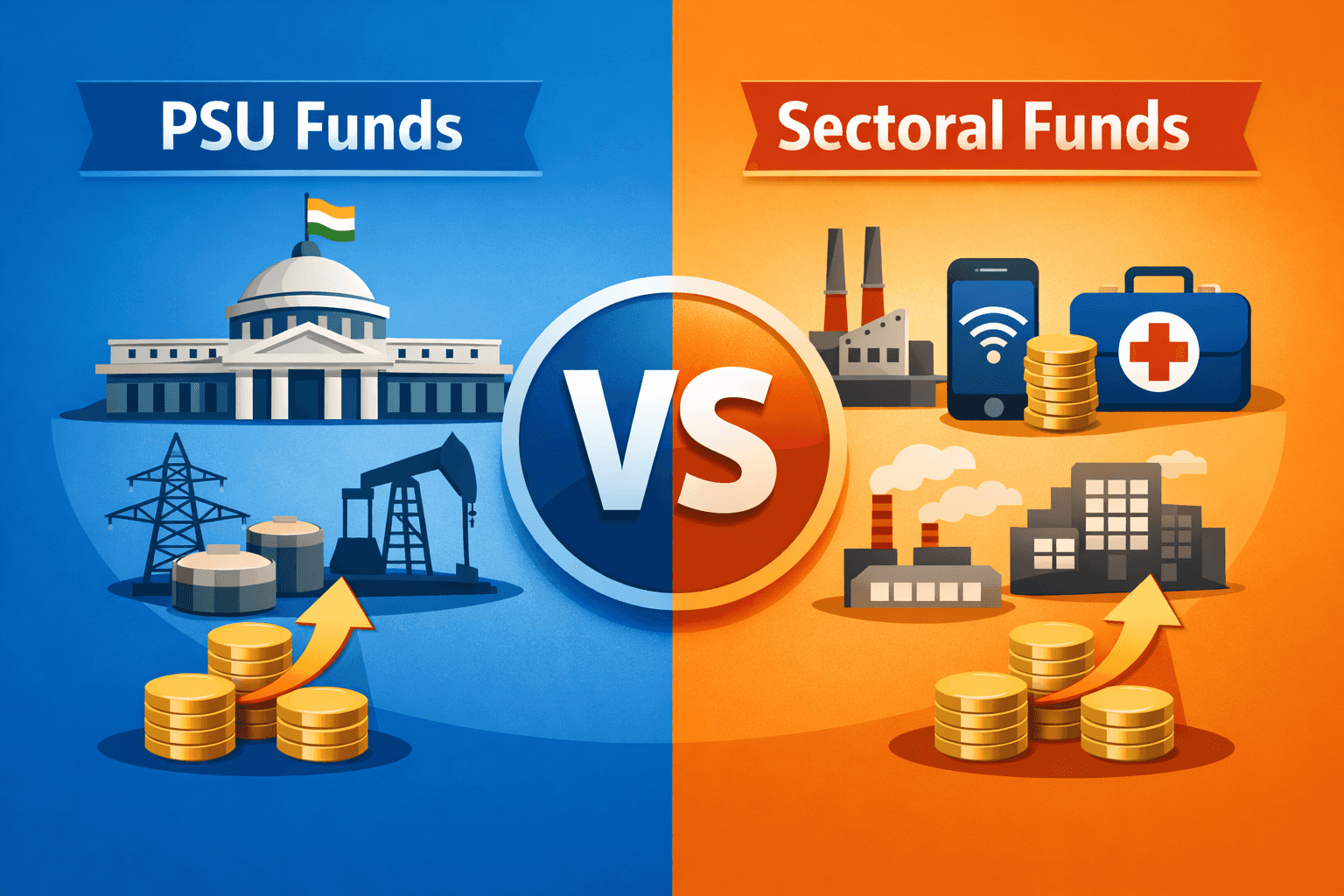
PSU mutual funds invest in government-owned companies across sectors, while sectoral funds invest in a single industry, such as IT or pharma. PSU funds are driven by government policies, whereas sectoral funds depend on industry cycles.
If you’ve been exploring mutual funds, you have probably come across PSU and sectoral funds. They might look similar as both are concentrated, volatile, and potentially high-return. But in reality, they’re quite different. And that difference matters when you’re deciding where to put your money.
In this article, we will explain the differences and which suits you better.
What are PSU Mutual Funds?
A PSU (Public Sector Undertaking) fund invests primarily in companies owned or controlled by the government. Think of businesses like SBI, NTPC, ONGC, Coal India, or GAIL. These companies operate in core sectors like banking, energy, and infrastructure.
A fund like the SBI PSU Fund, for instance, builds its portfolio around such government-backed companies.
Now, why do investors look at PSU funds?
Because they tend to move in cycles. When government spending rises, or when there’s a push on infrastructure, defence, or energy, PSU stocks often rally sharply.
A recent example makes this clear. Between 2022 and early 2024, many PSU stocks saw a strong run. SBI stock alone delivered returns of over 100% in that period. Defence PSUs like HAL and BEL also surged due to the government's increased focus on indigenisation.
Funds that were heavily exposed to these names benefited from this trend.
But here’s the flip side. PSU funds can remain flat or underperform for long stretches. Between 2014 and 2020, many PSU stocks struggled due to weak balance sheets, policy delays, and low investor interest.
PSU funds can look great on paper right now, but they’ve also spent years doing almost nothing. That’s the part most people forget. They work best when the cycle turns in their favour.
What are sectoral funds?
Sectoral funds invest in a specific sector of the economy. This could be IT, pharma, banking, FMCG, infrastructure, or even newer themes like consumption or digital.
For example:
- An IT sector fund invests in companies such as Infosys, TCS, and Wipro.
- A pharma fund focuses on Sun Pharma, Dr Reddy’s, and Cipla.
- A banking fund invests in HDFC Bank, ICICI Bank, and Axis Bank.
Unlike PSU funds, sectoral funds are not limited to government-owned companies. They include both private and public players, as long as they belong to that sector.
Key Differences Between PSU Funds and Sectoral Funds
PSU funds invest in government-owned companies, while sectoral funds invest in industry (any company in a sector).
Here is the quick difference table:
|
Factor |
PSU Funds |
Sectoral Funds |
|
Investment Focus |
Government-owned companies |
Single sector |
|
Diversification |
Across sectors (but only PSUs) |
Within one sector only |
|
Risk Level |
Moderate to high |
High |
|
Dependency |
Government policies, disinvestment |
Sector performance |
Here’s the simplest way to think about it:
- PSU funds = Ownership theme (government-owned companies)
- Sectoral funds = Industry theme (specific sector regardless of ownership)
That means a PSU fund can be spread across multiple sectors, such as banking, oil, and power, as long as the companies are government-owned.
But a sectoral fund is focused on one industry, regardless of whether the companies are private or public.
Risk and return: Which one is riskier?
Both are higher risk than diversified equity funds. But the nature of risk is different.
PSU funds are driven heavily by:
- Government policies
- Disinvestment plans
- Budget announcements
- Macro themes like infrastructure push
Sectoral funds, on the other hand, depend on:
- Industry cycles
- Global demand (especially for IT and pharma)
- Commodity prices (for metal or energy funds)
For example, IT funds did exceptionally well during 2020–2021 due to global digital demand. But they corrected in 2022 when growth slowed and valuations became expensive.
Similarly, PSU funds rallied when government capex picked up. But if that slows down, returns can cool off quickly.
Historically, sectoral funds tend to deliver sharper short-term rallies, while PSU funds perform during government-led capex cycles.
Which one should you choose?
This depends less on “which is better” and more on “what you’re trying to achieve.”
You can consider PSU funds if:
- You believe in a government-led capex cycle.
- You want exposure to undervalued public sector companies.
- You understand that returns can be cyclical and uneven.
You can consider sectoral funds if:
- You have a strong view on a particular sector (like IT, pharma, or banking)
- You’re comfortable tracking sector-specific trends.
- You’re okay with timing risk.
Don’t chase past returns. Just because PSU funds performed well recently doesn’t mean they’ll continue to do so. The same goes for sectoral funds. These categories work in cycles. By the time performance looks attractive on paper, a big part of the rally may already be over.
Bottom Line
PSU funds and sectoral funds both have their place, but they’re not core portfolio investments. Think of them as tactical bets rather than long-term anchors.
If you want to take exposure to government-driven growth, funds like the SBI PSU Fund can help you do that in a structured way. But go in with realistic expectations.
Ultimately, the goal is not to pick the trending category. It’s to build a portfolio that you can stick with across market cycles.