
PSU vs CPSE: Key Differences in India's Public Sector Companies – Full Details 2026
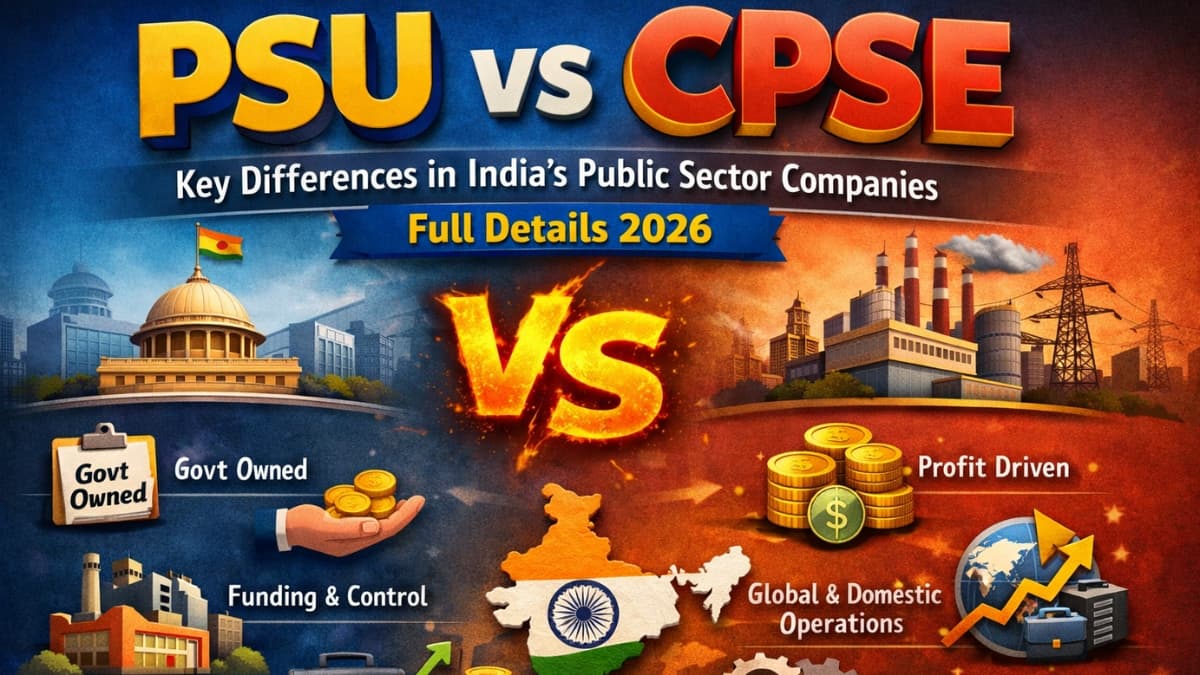
New Delhi: In India's economy, Public Sector Undertakings (PSUs) play a vital role in sectors like energy, banking, infrastructure, defense, and more. People often confuse PSU with CPSE (Central Public Sector Enterprise) or use them interchangeably. But are they the same? Let's break it down with the latest accurate information as of 2026.
What is a PSU?
Public Sector Undertaking (PSU) is a broad term for government-owned companies where the government (central or state) holds at least 51% stake. These entities operate commercially to generate profits while serving public interest and national development.
PSUs are mainly divided into two categories:
- Central PSUs (also called CPSEs or CPSUs) — Controlled by the central government.
- State PSUs (SPSUs) — Controlled by state governments.
Examples: SBI, ONGC, and NTPC are central-level PSUs (CPSEs), while many state electricity boards, transport corporations, or irrigation companies fall under state PSUs.
What is a CPSE?
Central Public Sector Enterprise (CPSE) refers specifically to PSUs owned and controlled by the central government (or other CPSEs). The Department of Public Enterprises (DPE) under the Ministry of Finance oversees their policy, performance, and guidelines.
CPSEs are often called CPSUs in common usage. They operate on a national or international scale in strategic sectors like:
- Energy (NTPC, ONGC, IOCL)
- Banking (SBI, PNB)
- Defense (HAL, BEL)
- Heavy industries (BHEL, SAIL)
As per the latest data (Public Enterprises Survey and reports up to 2025-26):
- Total CPSEs (including subsidiaries): Around 448 (as of early 2026).
- Operational CPSEs: Approximately 291.
- Profit-making: Around 227-226.
- Loss-making: Around 63.
Among them:
- 14 Maharatna companies (e.g., ONGC, IOCL, NTPC, HAL – latest addition in recent years).
- 26 Navratna.
- 65+ Miniratna (Category I & II).
These statuses give greater financial and operational autonomy.
PSU vs CPSE: Main Differences (Table for Quick Understanding)
| Parameter | PSU (General) | CPSE (Central PSU) |
|---|---|---|
| Definition | Any company with ≥51% govt stake (central or state) | PSUs specifically under central government control |
| Ownership | Central govt, state govt, or mix | Central govt or other CPSEs (≥51%) |
| Governing Body | DPE (for central), respective state depts | Department of Public Enterprises (DPE) |
| Examples | SBI, NTPC (CPSE) + state power companies | ONGC, NTPC, IOCL, BHEL, SAIL, HAL |
| Scale & Scope | Varies (small regional to large national) | Mostly large-scale, national/strategic importance |
| Total Number (approx) | Thousands (central + all states) | ~448 total, ~291 operational (2025-26 data) |
| Focus | Regional/national development | National priorities, infrastructure, defense |
Key takeaway: All CPSEs are PSUs, but not all PSUs are CPSEs. CPSE is a subset — only the central government-controlled ones.
Current Status of PSUs/CPSEs in 2026
- CPSEs showed strong performance in recent years, with many recording record profits (listed ones crossed ₹5 lakh crore+ in combined profits in recent fiscal years).
- Government continues strategic disinvestment in non-core areas while strengthening key sectors.
- Profit-making CPSEs increased significantly (from ~157 in FY15 to ~227 in FY25), and loss-making ones declined.
- Popular investment options like CPSE ETF provide exposure to top central PSUs.
- Maharatna companies enjoy high autonomy for global expansion.
Conclusion
When people talk about "PSU jobs," "PSU stocks," or "PSU exams," they usually mean central-level ones (CPSEs), as they dominate headlines and opportunities. However, technically, CPSE is the precise term for central government PSUs.