
FD vs Debt Mutual Funds After RBI Repo Rate Hold – 2026
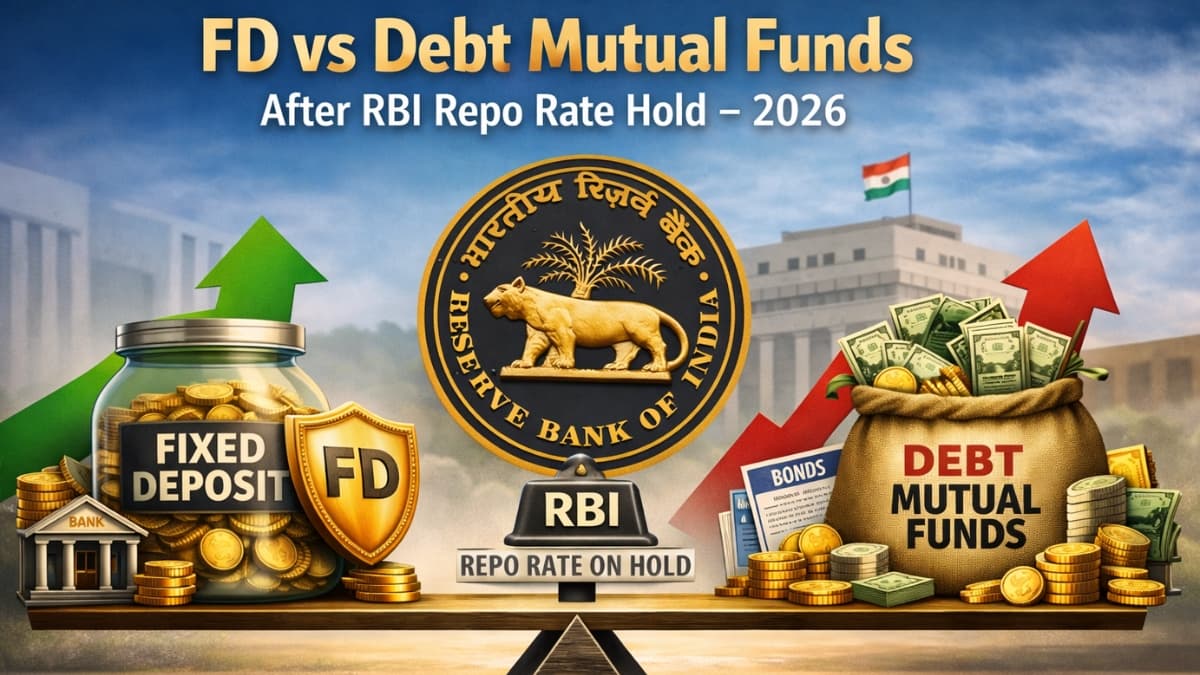
New Delhi Feb 23, 2026: The Reserve Bank of India (RBI) announced its Monetary Policy decision on February 6, 2026, keeping the repo rate unchanged at 5.25%. The Monetary Policy Committee (MPC) maintained a neutral stance, indicating a data-dependent approach going forward.
The current policy setting follows earlier rate adjustments over the past year. According to official projections, inflation remains moderate (FY26 estimate around 2%–2.1%), while economic growth expectations have been placed near 7.4% for FY26. The policy statement also referenced ongoing monitoring of global and domestic developments.
With policy rates currently steady, the broader interest rate environment appears relatively stable as of late February 2026.
Economic Snapshot – Late February 2026
-
Repo Rate: 5.25%
-
Standing Deposit Facility (SDF): 5.00%
-
MSF / Bank Rate: 5.50%
-
Inflation Outlook: Moderate, as per official projections
-
Growth Outlook: Stable, with positive domestic momentum
-
Bond Market: Yields largely steady
-
FD Rates: Broadly stable across most banks
In this environment, fixed-income instruments such as Fixed Deposits (FDs) and Debt Mutual Funds remain commonly evaluated options for surplus allocation.
Also Read: Latest FD Rates 2026: SBI, PNB, ICICI, BoB, Canara Bank & HDFC, Axis After RBI Repo Rate Pause
Fixed Deposits vs Debt Mutual Funds
February 2026 Overview
| Parameter | Fixed Deposits (FDs) | Debt Mutual Funds |
|---|---|---|
| Nature of Returns | Fixed and predetermined at the time of booking | Market-linked; dependent on portfolio yields and interest rate movements |
| Typical Yield Range | ~6%–7.9% p.a. (higher slabs in select small finance banks); senior citizens typically receive an additional 0.5%–0.85% | Many corporate bond and short-duration categories have shown trailing 1-year returns in the 7%–10% range (subject to change) |
| Risk Profile | Low; covered under DICGC insurance up to ₹5 lakh per depositor per bank | Low to moderate; subject to interest rate risk and limited credit risk; no guaranteed returns |
| Liquidity | Premature withdrawal allowed with penalty (usually 0.5%–1%) | Typically T+1 or T+2 redemption; some schemes may carry exit loads |
| Tax Treatment | Interest taxed at slab rate; TDS applicable above prescribed limits | Gains taxed at slab rate (as per prevailing tax rules); no indexation benefit |
| Volatility | No NAV fluctuation | NAV may fluctuate based on bond yields |
Fixed Deposits: Key Characteristics
-
Interest rate is fixed at the time of investment
-
Suitable for defined time horizons
-
No market-linked volatility
-
Senior citizen additional interest benefit available
-
Deposit insurance available as per DICGC guidelines
FD rates across PSU, private, and small finance banks currently range between approximately 6% and 8%, depending on tenure and category.
Debt Mutual Funds: Key Characteristics
-
Invest in government securities, corporate bonds, or money market instruments
-
Returns are influenced by interest rate movements and accrual income
-
Higher liquidity compared to traditional FDs
-
NAV may fluctuate in the short term
-
No capital guarantee
Categories commonly tracked include corporate bond funds, short-duration funds, and dynamic bond funds.
Allocation Considerations in a Stable Rate Environment
With policy rates steady:
-
Fixed Deposits provide predictable accrual at currently available rates
-
Debt Mutual Funds reflect ongoing yield accrual from bond portfolios
-
Interest rate movements may influence debt fund performance in future periods
Investment decisions typically depend on:
-
Investment horizon
-
Liquidity requirements
-
Risk tolerance
-
Tax bracket
-
Overall asset allocation strategy
Important Information
-
Interest rates and fund yields are subject to change.
-
Debt mutual fund returns are not guaranteed and may fluctuate.
-
Deposit insurance is applicable as per prevailing DICGC regulations.
-
Investors are advised to review official bank websites and AMFI/fund house disclosures for updated data.
-
This content is for informational purposes only and should not be construed as financial advice.
Conclusion
As of late February 2026, the interest rate environment remains stable following the RBI’s policy decision. Both Fixed Deposits and Debt Mutual Funds continue to serve different roles within fixed-income allocation frameworks. The appropriate choice varies based on individual financial objectives and risk preferences.
Disclaimer: The information provided in this article is for informational purposes only. FD rates, Mutual Funds and schemes have been collected from publicly available sources, including bank websites and Google search. Readers are advised to verify details with the respective banks before making any investment decisions. The publisher is not responsible for any errors or financial losses.