
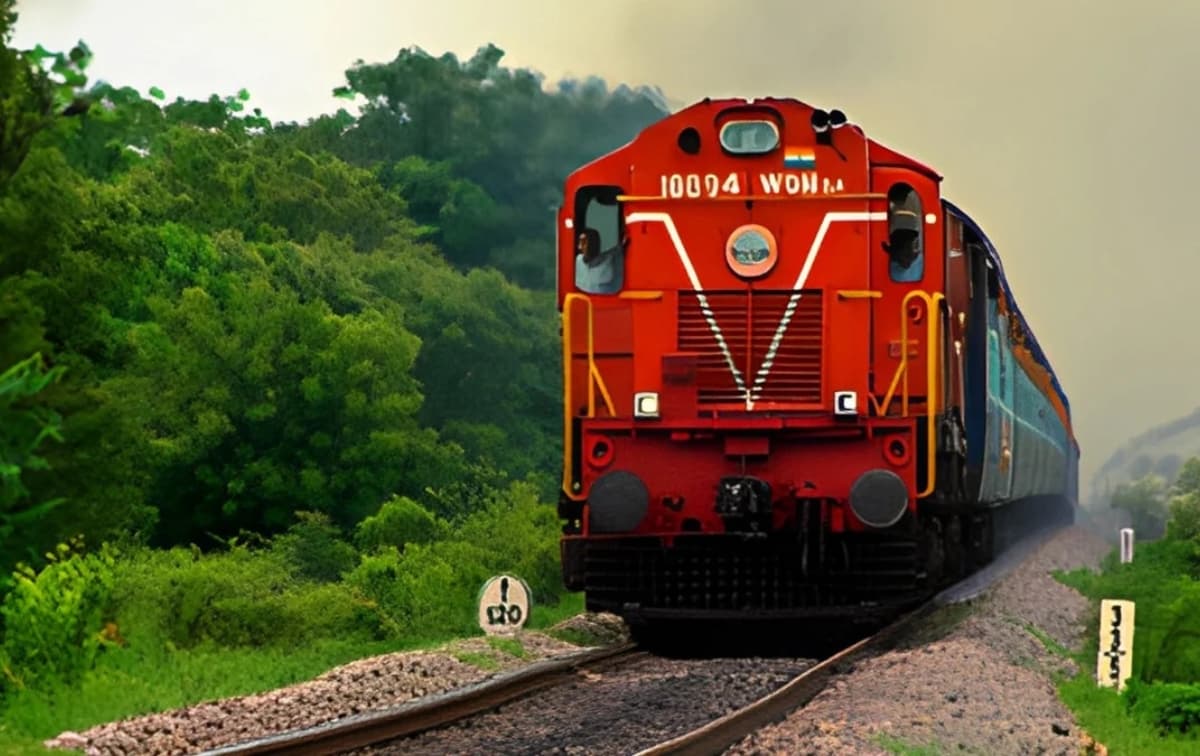
New Delhi: In a significant update shared in the Lok Sabha on December 17, 2025, Union Minister Shri Ashwini Vaishnaw informed that Indian Railways has achieved 99.2% electrification of its total Broad Gauge network, bringing the national transporter to the threshold of a historic milestone. This achievement marks one of the fastest large-scale railway electrification drives undertaken anywhere in the world.
Globally, India now stands among the leaders in railway electrification. As per the International Union of Railways (UIC) report of June 2025, India’s electrification level of 99.2% places it just behind Switzerland, which has achieved 100% electrification. India has significantly outpaced several advanced economies, including China (82%), Spain (67%), Japan (64%), France (60%), Russia (52%), and the United Kingdom (39%), underlining the scale and speed of its infrastructure transformation.
The progress achieved since 2014 has been particularly remarkable. In the six decades prior to 2014, Indian Railways had electrified about 21,801 route kilometres. However, in the last 11 years alone (2014–2025), an additional 46,900 route kilometres have been electrified under a focused mission-mode approach, more than doubling the pace of electrification.
This transformation is also reflected across regions. Fourteen railway zones, including Central, Eastern, Northern, and Western Railways, have now achieved 100% electrification. At the state level, 25 States and Union Territories are fully electrified. Notably, several North Eastern states such as Arunachal Pradesh, Meghalaya, Nagaland, Tripura, and Mizoram have achieved complete electrification of their existing Broad Gauge networks, marking a major infrastructure leap for the region.
Beyond operational efficiency, electrification plays a critical role in Indian Railways’ ambition to become a Net-Zero Carbon Emitter by 2030. According to a NITI Aayog report, rail transport is far more environmentally sustainable than road transport. Carbon dioxide emissions from road transport stand at about 101 grams per tonne-kilometre, while rail emits only 11.5 grams per tonne-kilometre, making rail nearly 89% cle