
CWPRS, NIH and CWC Sign MoU on Non-Contact River Flow Measurement
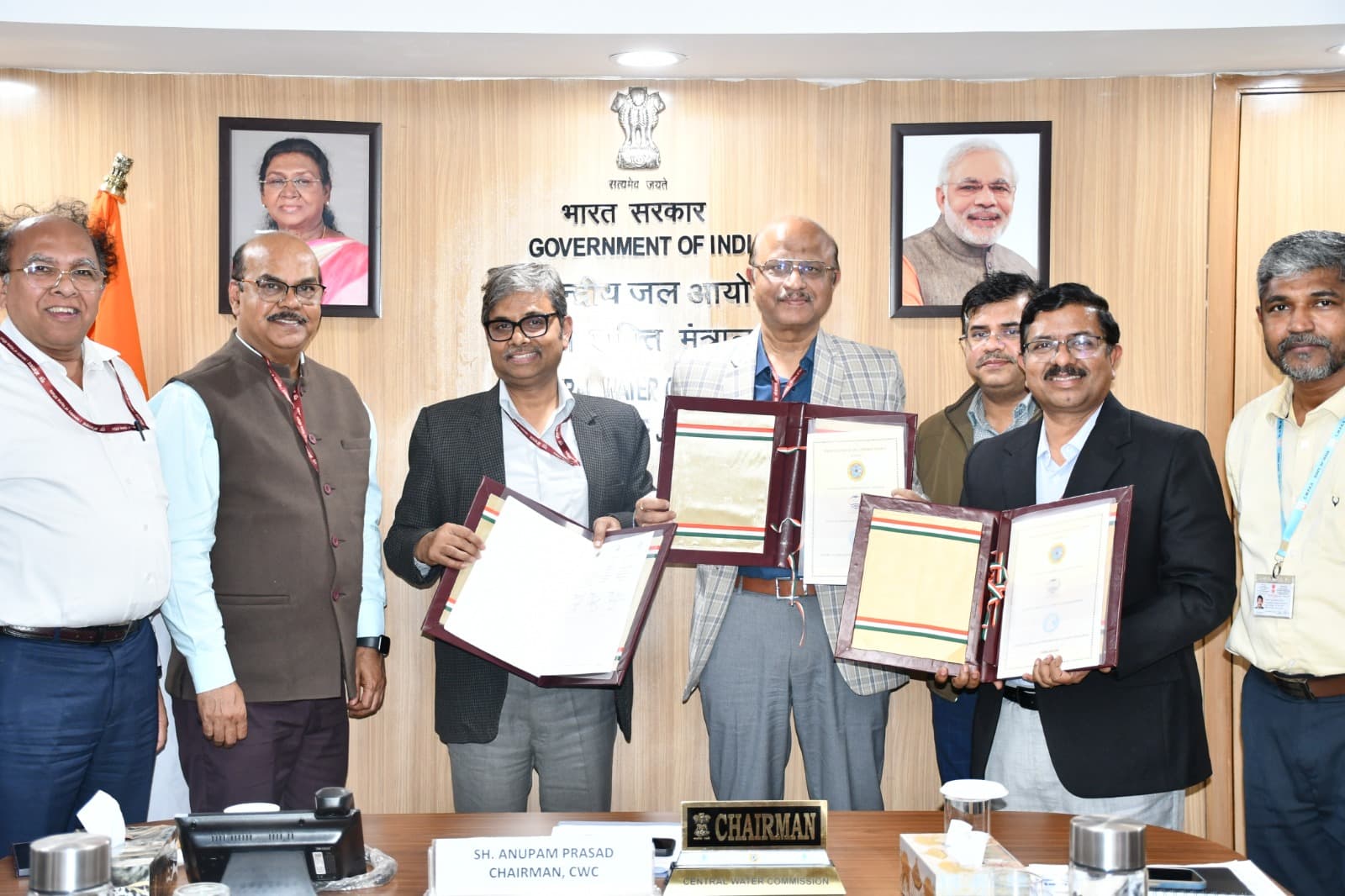
New Delhi, February 18: In a significant step towards modernising India’s water monitoring systems, an innovative Memorandum of Understanding (MoU) was signed between the Central Water and Power Research Station (CWPRS), the National Institute of Hydrology (NIH), and the Central Water Commission (CWC) to promote advanced non-contact techniques for measuring flow and discharge in rivers and canals.
The MoU was executed at the office of the Chairman, CWC, in New Delhi in the presence of Shri Anupam Prasad, Chairman, CWC.
Focus on Non-Contact Discharge Measurement
The agreement aims to strengthen collaboration on various non-contact open channel flow and discharge measurement techniques, which are increasingly being adopted globally to enhance accuracy, safety and efficiency in hydrological assessments.
Traditional methods often require physical instruments to be placed directly in flowing water, which can pose challenges during floods, high flows or in inaccessible areas. Non-contact techniques, by contrast, rely on advanced sensors, radar, imaging systems and remote technologies to measure water discharge without physically entering the stream.
Officials said this partnership will help standardise discharge measurement methods based on site-specific suitability, ensuring that the most appropriate technology is deployed depending on river conditions, canal structure and environmental factors.
Leadership and Signatories
The MoU was signed by:
-
Shri D.P. Mathuria, Chief Engineer, CWC
-
Dr. Prabhat Chandra, Director, CWPRS
-
Dr. Y.R.S. Rao, Director, NIH
The signing ceremony was held in the august presence of Shri Anupam Prasad, Chairman, CWC.
Strengthening India’s Water Management Framework
The collaboration is expected to create a structured developmental model for modern flow measurement practices in India. By integrating research expertise, field experience and regulatory oversight, the three institutions aim to improve the reliability of discharge data used in flood forecasting, irrigation planning, reservoir management and water resource allocation.
Experts believe that standardising measurement techniques across sites will also enhance data consistency and improve long-term hydrological modelling.
The initiative marks a coordinated effort by key national water institutions to adopt technology-driven solutions and strengthen scientific water resource management in the country.