
India’s Solar Momentum 2025: India Crosses 129 GW Solar Capacity
New Delhi: India has achieved a major clean-energy milestone in 2025, with solar power capacity surging to 129 GW, marking a dramatic rise from just 3 GW in 2014. This achievement has propelled the country’s non-fossil electricity capacity to over 259 GW, taking its share to more than 50% of India’s total installed power capacity—a historic shift towards low-carbon energy.
As the founding member and host of the International Solar Alliance (ISA) headquartered in Gurugram, India continues to play a pivotal global leadership role in accelerating solar deployment, technology transfer, and climate collaboration. In October 2025, India successfully hosted the 8th Assembly of the ISA in New Delhi, bringing together over 550 delegates and more than 30 ministers from
Solar Expansion: Over 40-fold Growth in a Decade
India’s solar sector has grown at an unprecedented pace, expanding more than 40 times in ten years. As of October 2025:
-
Solar capacity: 129.92 GW
-
Ground-mounted solar: 98.72 GW
-
Rooftop solar: 22.42 GW
-
Hybrid projects (solar component): 3.32 GW
-
Off-grid solar: 5.45 GW
According to IRENA Renewable Energy Statistics 2025, India now ranks:
-
3rd globally in solar energy
-
4th in wind energy
-
4th in total installed renewable energy capacity
This reflects India’s strategic rise as a global clean-energy powerhouse.
Driving the Transition: Policy Framework Under Panchamrit
India’s renewable energy progress is aligned with commitments under the Panchamrit Declaration announced at COP26, which outlines:
-
500 GW non-fossil electricity capacity by 2030
-
50% of installed capacity from non-fossil sources by 2030
-
1 billion tonnes reduction in carbon emissions by 2030
-
45% carbon-intensity reduction from 2005 levels
-
Net-zero emissions by 2070
Flagship Programmes Powering India’s Solar Growth
PM Surya Ghar: Empowering Households with Rooftop Solar
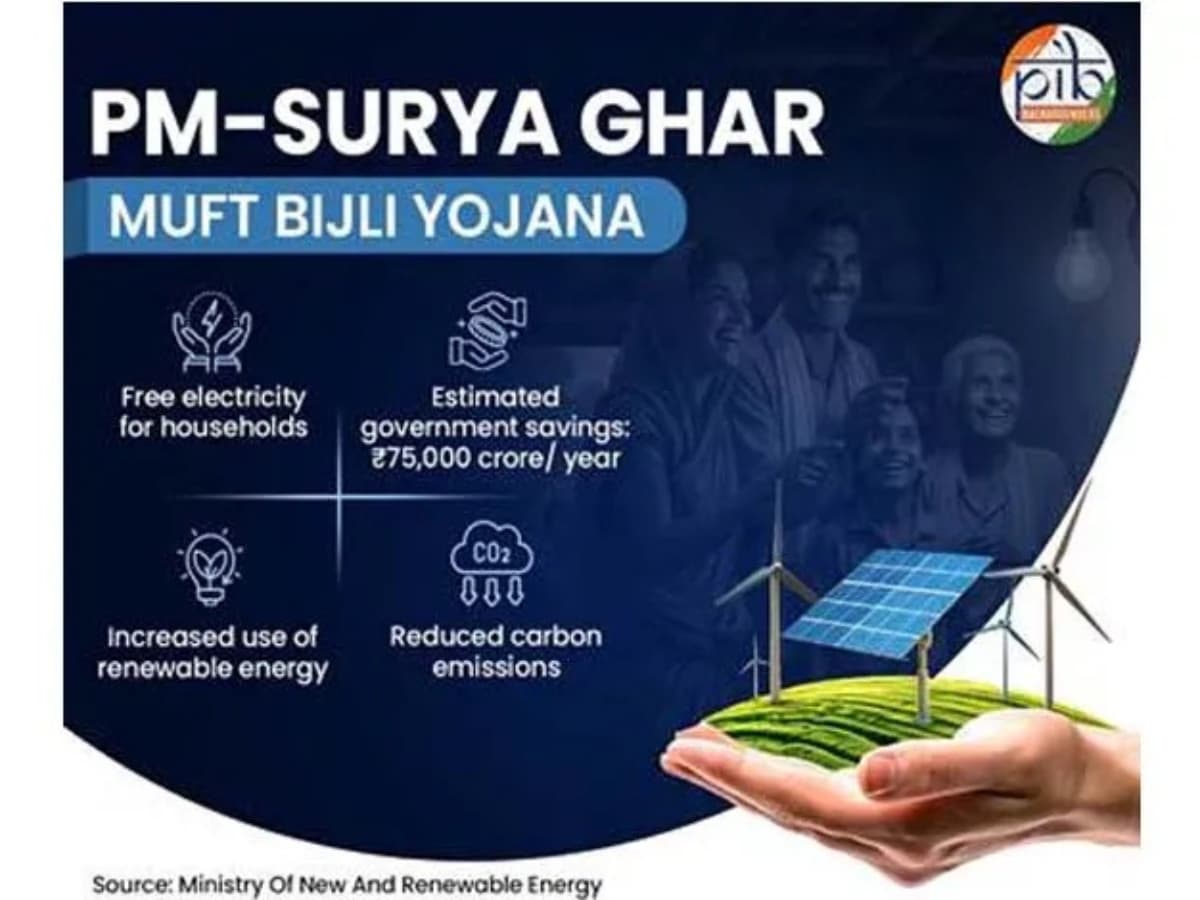
Launched in February 2024 with a budget of ₹75,021 crore, the mission aims to provide rooftop solar to 1 crore households.
As of December 2025:
-
23.9 lakh households installed rooftop solar
-
7 GW rooftop solar capacity
-
₹13,464.6 crore subsidy disbursed
The scheme ensures up to 300 units of free electricity monthly for beneficiaries.
National Solar Mission: Strengthening the Clean-Energy Backbone
The National Solar Mission (NSM), launched in 2010, continues to anchor India’s large-scale solar deployment. Its focus on technology diversification and policy support has enabled exponential growth and reduced dependence on fossil fuels.
PLI Scheme for High-Efficiency Solar PV Manufacturing
The Production Linked Incentive (PLI) Scheme, with a total outlay of ₹24,000 crore, aims to establish Giga-scale integrated solar manufacturing in India.
-
Investment attracted by June 2025: ₹48,120 crore
-
Jobs generated: ~38,500
-
Awarded manufacturing capacity: 48,337 MW
This initiative strengthens India’s position in the global solar supply chain and promotes energy self-reliance.
PM-KUSUM: Solar Power for Farmers
The PM-KUSUM scheme is transforming agriculture by enabling farmers to become energy producers.
Progress as of October 2025:
-
9+ lakh standalone solar pumps installed (Component B)
-
10,535 grid-connected pumps solarised
-
9,74,458 Feeder-Level Solarisation pumps completed
The scheme has been extended to March 2026, with enhanced CFA to support farmers in remote and hilly regions.
Solar Parks & Ultra-Mega Solar Projects
Under MNRE’s Solar Parks Scheme:
-
55 solar parks approved in 13 states
-
39,973 MW sanctioned capacity
-
14,922 MW already commissioned
The scheme has been extended to March 2029 to support completion of all sanctioned parks.
Global Leadership: Powering International Solar Collaboration
India continues to lead global solar initiatives through:
International Solar Alliance (ISA)
-
Over 125 member nations
-
Focus on solar finance, resilient supply chains, digital inclusion, and skill development
-
Four strategic pillars adopted at the 8th Assembly:
-
Catalytic Finance Hub
-
Global Capability Centre & Digitisation
-
Regional & Country Engagement
-
Technology Roadmap & Policy
-
President Droupadi Murmu reiterated at the ISA Assembly that solar energy is “a tool of empowerment and inclusive development”.
125+ Member and Signatory countries.
One Sun, One World, One Grid (OSOWOG)
Proposed by Prime Minister Narendra Modi in 2018, the OSOWOG initiative aims to create a global renewable energy grid, enabling solar-rich nations to supply clean power across borders. This initiative enhances global energy security and supports sustainable growth.
Conclusion
India’s solar momentum showcases how robust policy frameworks, technological innovation, and global cooperation can reshape a nation’s energy landscape. With solar energy emerging as the backbone of India’s renewable power mix, the country is firmly on track to achieving its clean-energy ambitions and contributing significantly to global climate goals.
India’s progress—fueled by domestic efforts and international leadership through ISA and OSOWOG—sets a global benchmark for a sustainable, inclusive, and solar-powered future.