
India Q3 FY26 GDP Growth: 7.8% Under New 2022-23 Base Year Series – Full FY26 at 7.6%, $4 Trillion by FY27
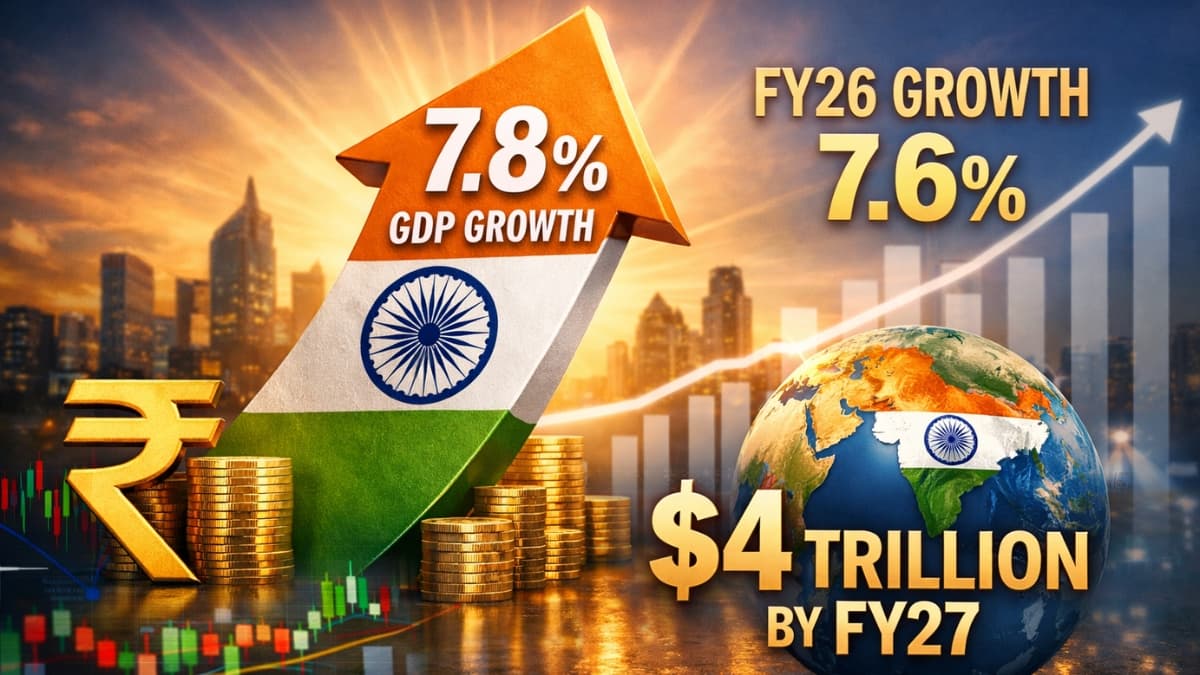
India's economy demonstrated strong resilience in the third quarter of fiscal year 2025-26 (October-December 2025), growing by 7.8% in real terms. This figure comes from the latest official data released by the Ministry of Statistics and Programme Implementation (MoSPI) on February 27, 2026, marking the first release under a newly revised GDP series with 2022-23 as the base year. The previous base year was 2011-12.
This 7.8% growth reflects a slight moderation from the 8.4% expansion in the second quarter (July-September 2025) but remains robust and above many pre-release economist expectations (which often hovered around 7.3-7.5%). Nominal GDP growth for the quarter stood at 8.9%, indicating moderate inflation influence.
Full-Year FY26 Performance and Revisions
For the entire financial year 2025-26 (April 2025-March 2026), the government's second advance estimates project real GDP growth at 7.6%. This is an upward revision from the earlier first advance estimate of 7.4% under the old series. Nominal GDP is estimated to grow by 8.6%.
The new series incorporates several improvements for greater accuracy:
- Updated sectoral weights reflecting post-COVID economic shifts.
- Better use of modern data sources like GST returns, e-way bills, vehicle registrations, and household surveys.
- Double deflation techniques in key sectors (manufacturing and agriculture) to remove price distortions more effectively.
- Enhanced coverage of the informal economy and services.
These changes aim to align India's national accounts more closely with global standards and provide a clearer picture of structural transformations.
Revisions to Past Years
The switch to the new base year has led to recalibrated growth figures for recent years:
- FY 2023-24: Real GDP growth revised to 7.2% (previously 9.2% under old series).
- FY 2024-25: Real GDP growth revised to 7.1% (previously 6.5%).
While real growth trends show continuity, nominal GDP sizes for recent years are lower due to methodological adjustments, reducing the overall economy size in rupee and dollar terms compared to prior projections.
Key Sectoral Insights
Manufacturing emerged as a standout performer, contributing significantly to the Q3 and full-year momentum through higher output and improved efficiency. Services continued to support growth steadily, while private consumption remained a reliable driver, boosted by festive demand and policy stability. Agriculture and mining showed more moderate contributions, reflecting weather and global commodity factors.
Overall, domestic demand—private consumption and investment—has been the primary engine, helping shield the economy from external pressures like global trade uncertainties.
Looking Ahead: FY27 Projections and $4 Trillion Milestone
Chief Economic Adviser V. Anantha Nageswaran stated that real GDP growth for FY 2026-27 (next fiscal year) is now projected at 7-7.4%, slightly higher than earlier forecasts in the Economic Survey. Nominal growth could approach 11%, supported by continued domestic strength, service exports, and policy continuity.
Regarding the long-term goal, Nageswaran noted that India is expected to comfortably cross the $4 trillion mark in GDP (in current dollar terms) during FY27 (2026-27), assuming an average exchange rate around ₹87 per dollar and sustained momentum. He emphasized that while timelines depend on exchange rates and global conditions, India remains firmly on track to rank among the world's top three or four economies in the coming years.
The revised data confirms India's position as the fastest-growing major economy globally, with consistent 7%+ real growth in recent years highlighting underlying resilience and structural improvements.
This updated framework offers policymakers, investors, and citizens a more precise lens to understand economic progress and plan for the future.
Disclaimer: This article is for educational purposes only and is compiled from publicly available sources accessed via Google search. It is not financial advice; always verify with official MoSPI data or consult professionals for decisions.