
SC Refers BPCL vs District Revenue Officer Stamp Duty Dispute to Larger Bench on Section 47-A
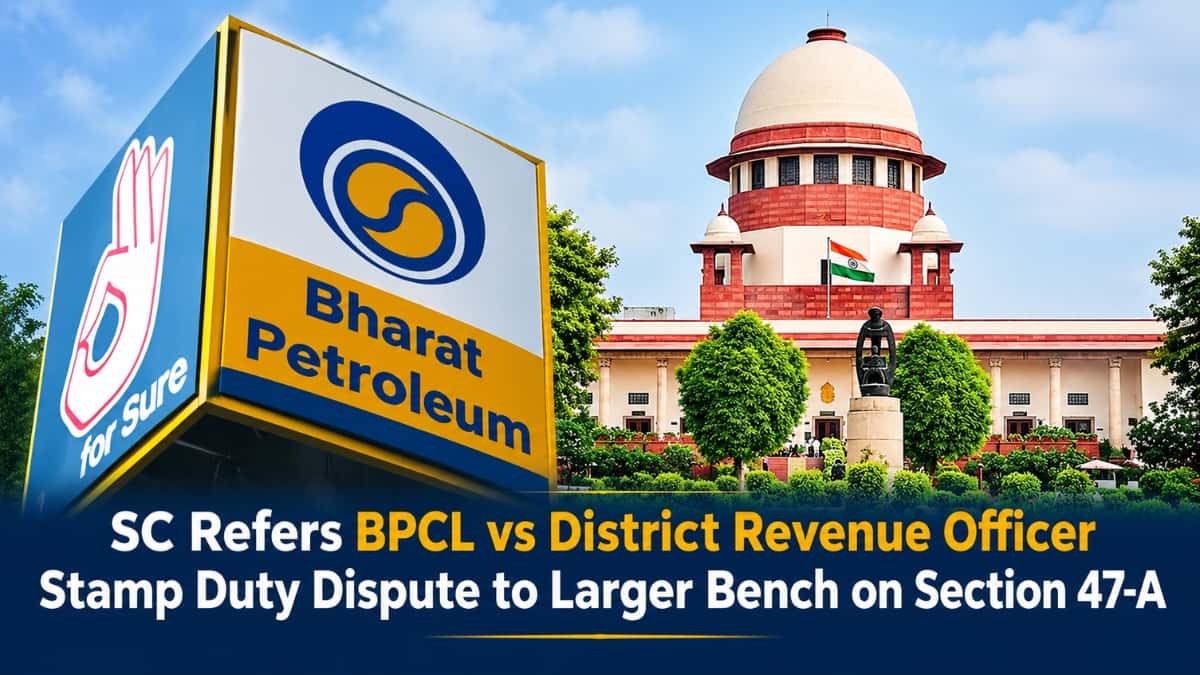
New Delhi, September 8, 2026: The Supreme Court of India has referred important questions of law arising from a stamp duty dispute involving Bharat Petroleum Corporation Limited (BPCL) to a larger Bench for authoritative consideration.
In Civil Appeal arising out of SLP (C) No. 37096 of 2025 (2026 INSC 963), a Bench of Justices Dipankar Datta and Sheel Nagu delivered the judgment on 7 September 2026.
Background of the Case
BPCL purchased land from the Government of India for a fixed consideration fully paid in 2014. Possession was delivered on 21 January 2014 and a transfer deed was executed on 24 June 2016. BPCL paid stamp duty and registration charges on the full consideration shown in the deed.
The registering authority, however, made a reference under Section 47-A of the Indian Stamp Act, 1899, alleging undervaluation based on the guideline value. A show-cause notice demanding additional stamp duty was issued. BPCL challenged the notice before the Madras High Court.
A Single Judge quashed the notice, relying on the Supreme Court’s earlier decision in V.N. Devadoss v. Chief Revenue Control Officer (2009). The Single Judge held that Section 47-A could be invoked only when there was material showing deliberate undervaluation with fraudulent intent to evade stamp duty.
The Division Bench of the Madras High Court reversed this order, restored the proceedings before the District Revenue Officer, and directed BPCL to participate in the statutory process.
Supreme Court’s Observations
The Supreme Court noted that the core issue was not the actual market value of the property but whether the statutory machinery under Section 47-A could validly be set in motion in the absence of material indicating fraudulent intention.
The Court examined the plain language of Section 47-A, which requires the registering officer only to have “reason to believe” that the market value or consideration has not been truly set forth in the instrument. The provision does not expressly require proof of wilful undervaluation or fraudulent intent.
While acknowledging that V.N. Devadoss (a three-Judge Bench decision) and the subsequent decision in ASL Vyapar (P) Ltd. read the requirement of fraudulent intention into the provision, the present Bench expressed serious doubt about the correctness of that interpretation.
The Court observed that importing a requirement of culpable mindset converts a valuation enquiry into a quasi-criminal enquiry and can lead to injustice in both honest and dishonest transactions.
Questions Referred to Larger Bench
The Supreme Court has referred the following questions for consideration by a larger Bench:
-
Whether V.N. Devadoss correctly interprets Section 47-A as requiring wilful undervaluation with fraudulent intention to evade stamp duty, or whether the power can be exercised on the plain terms of the provision to determine the true market value irrespective of the parties’ mindset.
-
Whether the coordinate Bench decisions in Ramesh Chand Bansal and Shanti Bhushan correctly state the law.
The papers have been directed to be placed before the Hon’ble Chief Justice of India for constitution of an appropriate Bench.
The Court clarified that if V.N. Devadoss is upheld, the Single Judge’s order quashing the notice would stand justified; otherwise, the matter would proceed differently.
Citation: 2026 INSC 963
Bench: Justice Dipankar Datta and Justice Sheel Nagu
Date of Judgment: 7 September 2026
All details are taken from the official judgment of the Supreme Court of India. No facts have been altered.